Every AI system rests on a foundation of data, and that foundation is the AI data pipeline. While much of the attention goes to models and prompts, the teams that win with AI are usually the ones with the most reliable AI data pipelines underneath. This guide explains what an AI data pipeline is, how AI-powered data pipelines are architected, the components involved, and the best practices for building generative AI data pipelines that stay trustworthy at scale.
What is an AI data pipeline?
An AI data pipeline is the set of automated processes that collect, clean, transform and deliver data specifically for AI and machine learning workloads. It sits between your raw source systems and the models that consume the data, and it differs from a traditional analytics data pipeline in a few important ways: it often serves both training and inference, it must handle unstructured data such as text and images, and its outputs are frequently consumed by models that fail silently rather than loudly when the data is wrong.
If you are new to the broader concept, start with our guide to what an AI pipeline is, which places the data pipeline in the context of the full AI workflow.
AI data pipeline architecture
A modern AI data pipeline architecture typically has five layers. Each can be a managed service or self-hosted, but the responsibilities are consistent.
Ingestion layer
Connectors capture data from databases, SaaS APIs, event streams and files. The trend is toward continuous capture — streaming change data rather than periodic bulk loads — so that downstream AI features stay fresh. Whatever the method, ingestion should be incremental and idempotent.
Storage layer
Raw and processed data lands in a lakehouse or warehouse, with object storage underneath. Storage choices have an outsized effect on cost and throughput for AI workloads, which is why we devote a whole article to storage for AI pipelines.
Transformation layer
This is where raw data becomes model-ready features: cleaning, joining, deduplication, normalisation and enrichment. Many teams implement this layer with SQL and frameworks like dbt; increasingly the same layer is responsible for chunking and embedding text for retrieval in generative AI data pipelines.
Feature and vector layer
Engineered features are served to models through a feature store, and unstructured content is indexed in a vector database for retrieval-augmented generation. Consistency between what a model saw at training time and what it sees at inference time is the central challenge here.
Orchestration and observability layer
Tying it all together is orchestration — the control plane that decides what runs, in what order, and how failures are handled — plus observability for lineage, freshness and quality. This layer is what turns a collection of tools into a coherent, recoverable AI data pipeline.
Batch vs. streaming AI data pipelines
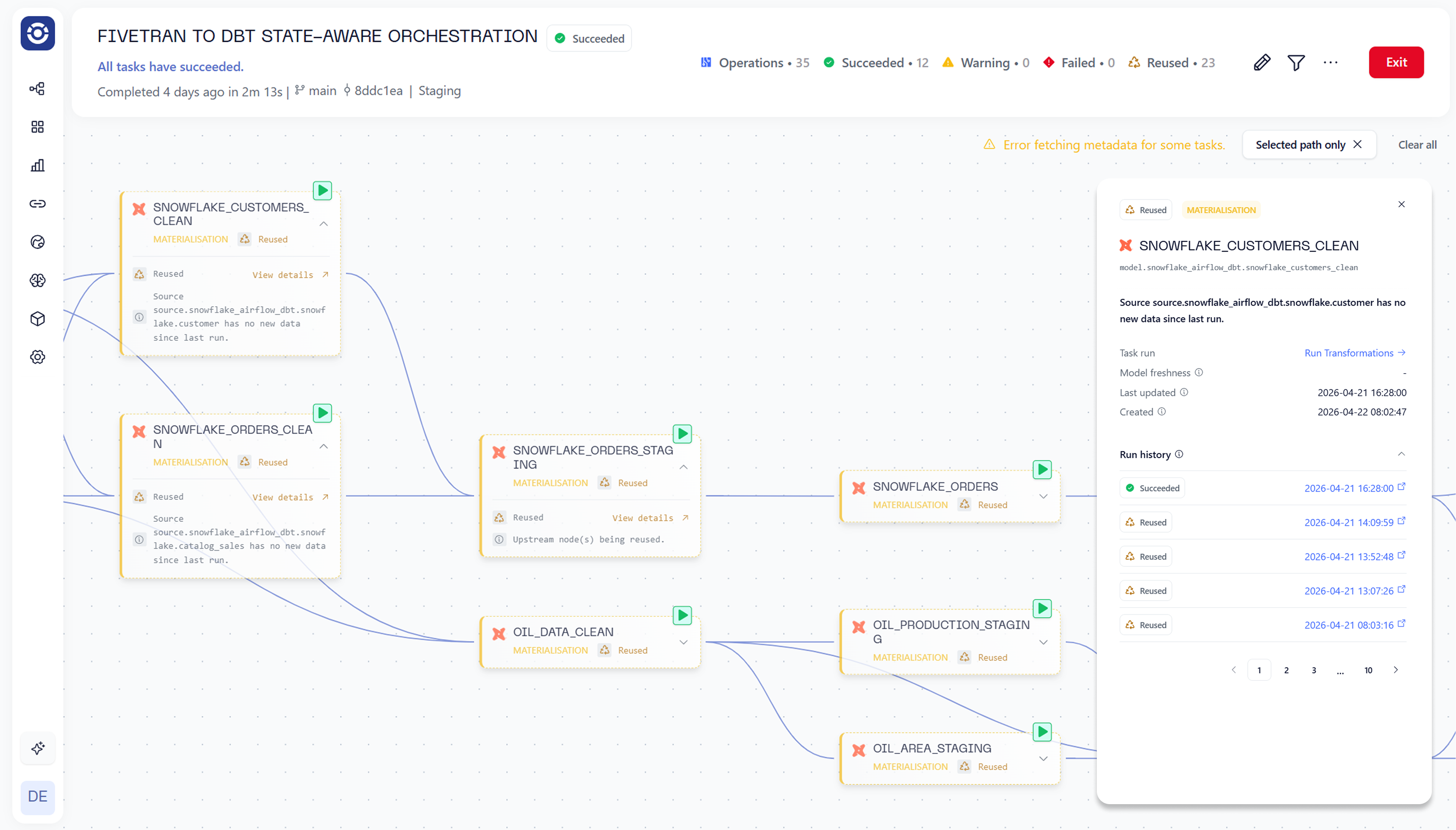
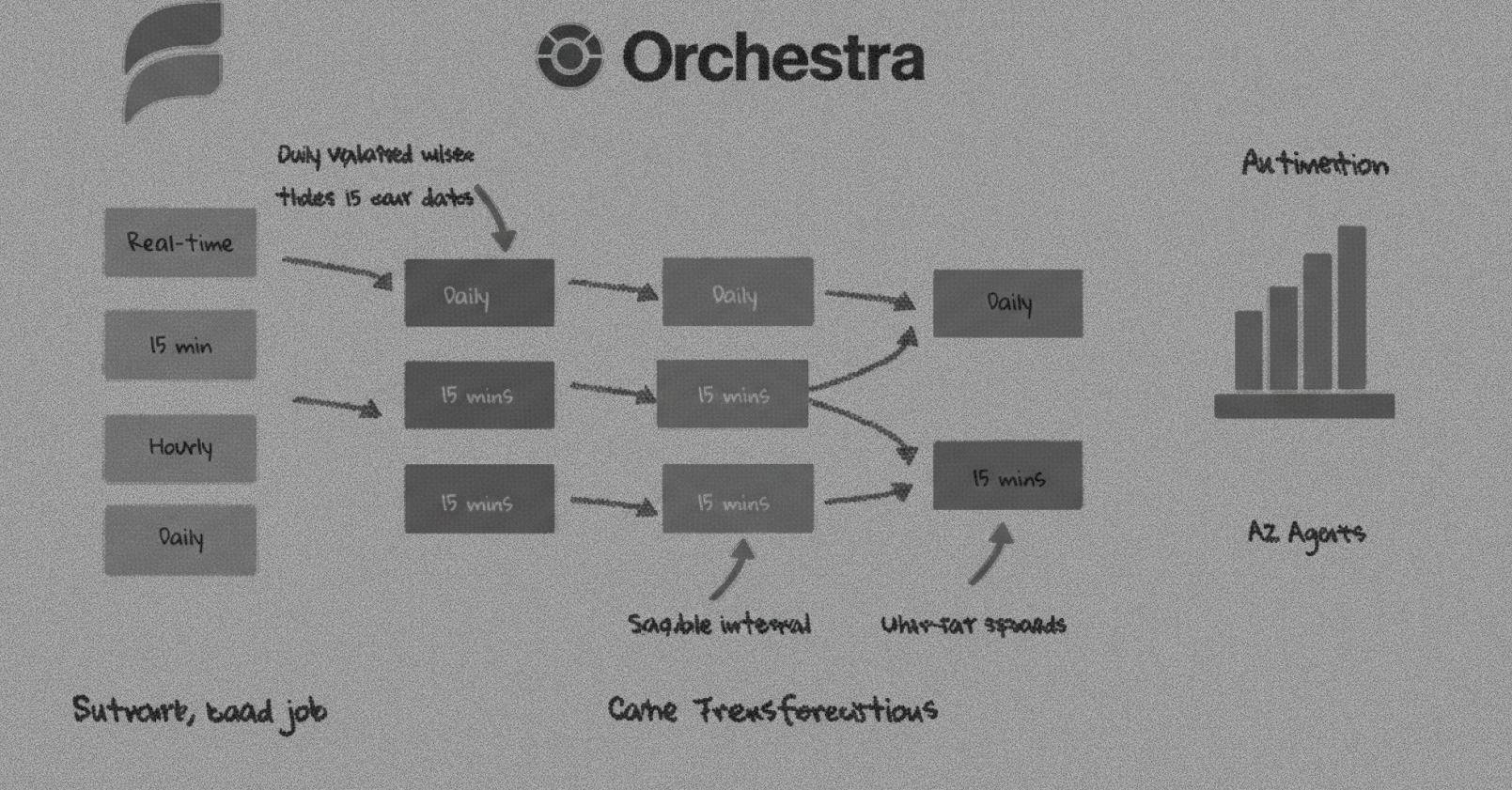
Training pipelines are usually batch: large volumes processed on a schedule. Inference and feature pipelines increasingly lean streaming, so that the data behind a live prediction is seconds old rather than hours. Most production systems run a hybrid, and the orchestration layer is responsible for keeping the two consistent. A powerful pattern is state-aware execution, where the pipeline processes only the data that has changed and propagates freshness requirements up the dependency tree, rather than blindly rebuilding everything on a clock.
Generative AI data pipelines
Generative AI adds new stages to the classic data pipeline. Text and documents must be parsed, chunked, embedded and indexed. Retrieval quality depends on getting this preprocessing right, and on keeping the vector index fresh as source content changes. The same engineering discipline that governs structured data — contracts, lineage, incremental processing — applies to these unstructured stages, and is often where generative AI projects quietly fail. Closely related is the AI ETL pipeline, which we cover separately.
Common AI data pipeline challenges
- Silent data quality failures. Models do not throw exceptions on bad input; they produce plausible, wrong output. Contracts and validation are essential.
- Training/serving skew. When the data a model sees in production differs from training data, accuracy degrades. Shared transformation logic prevents this.
- Freshness. Stale features and stale retrieval indexes are a leading cause of poor AI output.
- Cost. Reprocessing everything on every run is expensive; incremental, state-aware pipelines cut both cost and latency.
Best practices for AI-powered data pipelines
- Enforce data contracts at every ingestion boundary and fail closed on violations.
- Share transformation code between training and inference to eliminate skew.
- Process incrementally and propagate freshness SLAs rather than scheduling by clock.
- Track end-to-end lineage so you can answer “what is affected?” in seconds — see AI pipeline monitoring and observability.
- Version data and transformations so every model run is reproducible.
A reference AI data pipeline, end to end
It helps to walk a concrete example. Imagine a retailer building an AI data pipeline to power product recommendations and demand forecasts. The flow looks like this:
- Capture: change data from the transactional database streams continuously into the landing zone, while clickstream events arrive from the event bus and supplier feeds land as files in object storage.
- Validate: each source passes through contracts at the boundary — schema, types, ranges, freshness — and anything that fails is quarantined rather than propagated.
- Transform: raw events are cleaned, joined and aggregated into model-ready features, with the same transformation code used for training and serving to avoid skew.
- Serve: features land in a feature store; product descriptions and reviews are embedded and indexed in a vector store for retrieval.
- Orchestrate and observe: the whole flow is coordinated by a control plane that runs only what has changed, tracks lineage end to end, and alerts on freshness or quality violations.
The shape is identical whether you are a retailer, a bank or a biotech — only the sources and features change.
Data quality and contracts in depth
Because models fail silently, data quality is the central discipline of the AI data pipeline. A mature approach layers several defences. Contracts at ingestion catch malformed data at the door. In-pipeline tests assert business rules — uniqueness, referential integrity, plausible ranges. Anomaly detection watches for statistical drift that rules would miss. And a write-audit-publish pattern ensures nothing reaches a model or a consumer until it has passed validation. The goal is not to catch every possible error, but to make sure that when bad data appears, it is contained rather than amplified by the models downstream.
Real-time AI data pipelines and the lakehouse
The architecture that has emerged as the default for AI is the lakehouse: cheap, open object storage at the base, with warehouse-grade tables and governance on top. It lets a single copy of data serve both large-scale batch training and low-latency serving, reducing the duplication that plagues older architectures. Layered with streaming capture and state-aware processing, the lakehouse supports real-time AI data pipelines where features and retrieval indexes stay fresh continuously, without the cost of constant full rebuilds. For the storage trade-offs underneath, see storage for AI pipelines.
How Orchestra helps
Orchestra orchestrates AI-powered data pipelines from a single control plane, with end-to-end lineage, freshness SLAs and state-aware execution built in. Teams point their existing ingestion, warehouse and transformation tools at Orchestra and gain a reliable, observable AI data pipeline without writing glue code to hold it together.
Governance and access control in the AI data pipeline
As data flows through an AI data pipeline into training sets, prompts and vector indexes, governance becomes both harder and more important. Sensitive data can end up in places it should never be — a log, an embedding, a model output — and once a foundation model has seen it, you cannot simply delete it. A well-governed pipeline addresses this at the source: classifying data by sensitivity, enforcing access controls so only authorised processes and people can read it, masking or excluding regulated fields before they reach a model, and maintaining the lineage needed to honour deletion and residency requirements. None of this is exotic — it is the same governance discipline mature data teams already practise, extended to cover the new destinations that AI introduces. The cost of getting it wrong, however, is higher with AI, because the data spreads further and is harder to claw back. Treating governance as a property the pipeline enforces, rather than a policy people are asked to remember, is what keeps an AI data pipeline compliant as it scales.
Key takeaways
If you remember nothing else about the AI data pipeline, remember this. The data foundation, not the model, is what most often determines whether an AI system succeeds, because models fail silently on bad data. A sound architecture layers ingestion, storage, transformation, a feature and vector layer, and an orchestration and observability control plane that ties them together. The recurring failure modes — silent quality issues, training/serving skew, staleness and runaway cost — are all addressable with the same disciplines: contracts that fail closed, shared transformation logic, incremental and state-aware processing, end-to-end lineage, and governance enforced by the pipeline rather than by memory. Generative AI adds unstructured stages such as chunking, embedding and indexing, but the engineering principles carry over unchanged. Get these foundations right and your models inherit their reliability; get them wrong and no model, however sophisticated, will compensate.
Conclusion
The AI data pipeline is the unglamorous engine behind every successful AI system. Get the architecture, freshness and governance right and your models inherit that reliability. To go deeper, read about the AI ETL pipeline that prepares your data and the storage choices that determine its cost and speed.