Building and operating pipelines by hand does not scale. AI pipeline automation — using AI to design, build, run and maintain pipelines — is one of the fastest-moving areas in data engineering. This guide maps the landscape of AI pipeline tools, from visual pipeline builders to autonomous agents, and gives you a practical framework for choosing the best AI agents for data pipelines automation in 2026.
What is AI pipeline automation?
AI pipeline automation is the use of AI to reduce the manual effort of creating and operating data and AI pipelines. It spans a spectrum: at one end, AI assists a human (suggesting transformations, generating connectors); at the other, agents autonomously build and repair pipelines. Most teams live in the middle, using automation to remove toil while keeping humans accountable for critical decisions. For the foundations, see what an AI pipeline is.
Categories of AI pipeline tools
AI pipeline builders
A pipeline builder lets you assemble a pipeline visually or from natural language, with AI generating the underlying connectors and transformations. These tools lower the barrier to entry and speed up common cases, but the best ones still emit version-controlled, inspectable code rather than opaque configuration.
Orchestration platforms
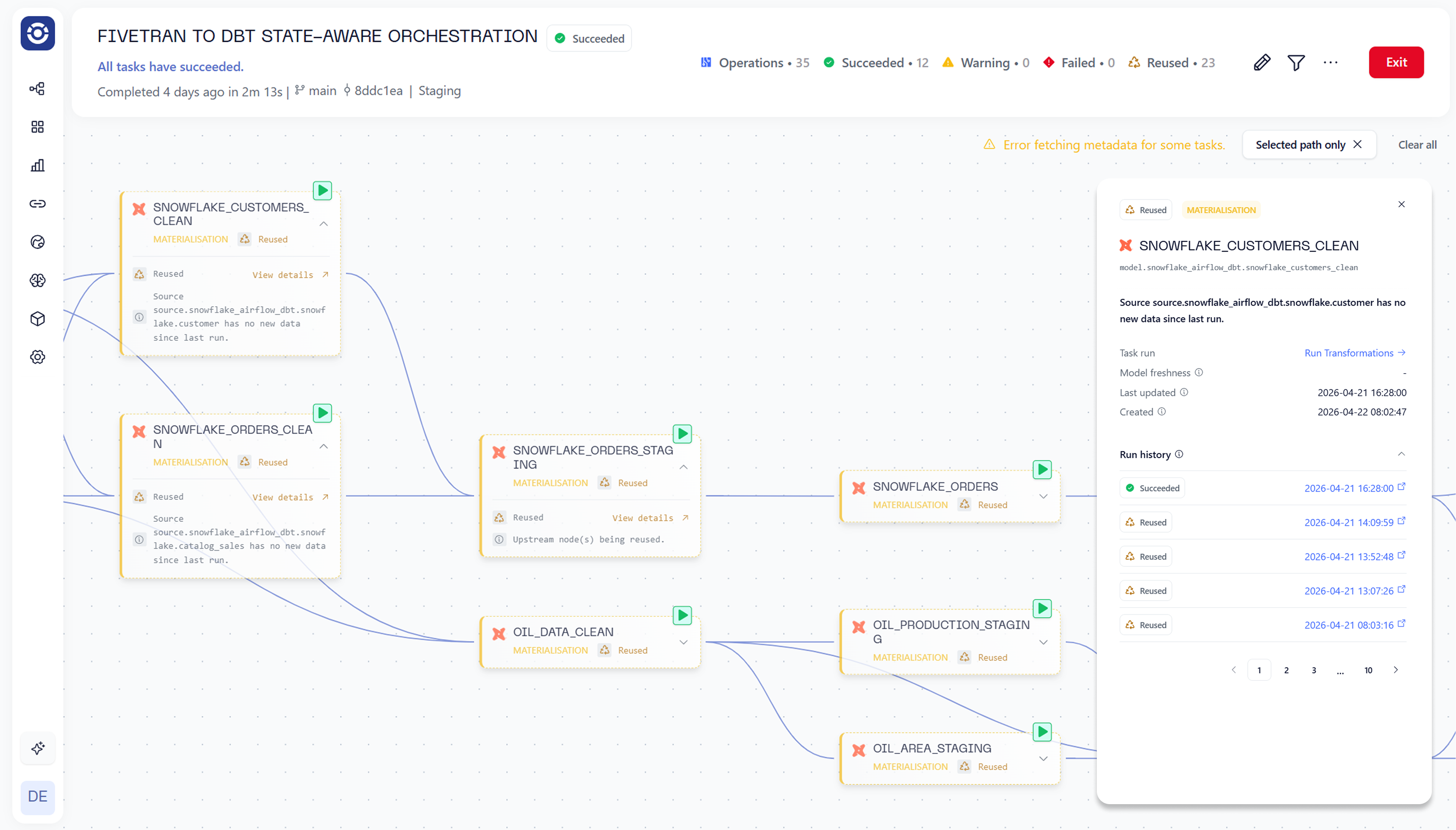
Orchestration is the control plane that decides what runs, when and in what order, handling dependencies, retries and recovery. AI is increasingly embedded here for failure triage and optimisation. This is the layer that turns individual tasks into a reliable pipeline.
AI-native data integration and ETL
Tools that apply AI to extraction and transformation — the AI ETL pipeline category — automate the brittle work of connecting and mapping sources.
Agentic automation
The newest category uses an agentic AI pipeline to build and operate pipelines: agents that profile data, propose models, write tests and respond to incidents. Powerful, but to be adopted with bounded autonomy and strong observability.
How to choose the best AI agents for data pipelines automation in 2026
The market is noisy and every vendor claims to be AI-powered. Cut through it with a concrete evaluation framework:
- Transparency. Does the tool produce inspectable, version-controlled artefacts, or opaque magic you cannot debug?
- Reliability features. Does it support idempotency, incremental processing, retries and recovery — or just happy-path automation?
- Observability. Can you trace lineage and diagnose failures? See AI pipeline monitoring and observability.
- Governance. Does it enforce contracts, access control and audit?
- Interoperability. Does it work with your existing warehouse, transformation and storage tools, or demand a rip-and-replace?
- Bounded autonomy. For agentic tools, can you constrain what they are allowed to do and require approval for high-risk actions?
Build vs. buy
You can assemble AI pipeline automation from open-source parts or adopt a platform. Building gives control but consumes engineering time on undifferentiated plumbing; buying accelerates delivery but requires diligence on lock-in and transparency. A pragmatic middle path is a platform that orchestrates your existing tools rather than replacing them.
Pitfalls to avoid
- Automating a broken process — fix the pipeline design before you automate it.
- Opaque automation you cannot debug when it inevitably fails.
- Unbounded agents with no cost, scope or approval limits.
- Tools that ignore governance, leaving you unable to audit AI-driven changes.
Levels of pipeline automation
It helps to think of AI pipeline automation as a spectrum of autonomy, much like self-driving cars, rather than an all-or-nothing switch:
- Level 0 – Manual. Humans write and run everything; tools just execute.
- Level 1 – Assisted. AI suggests transformations, generates boilerplate and completes code, but humans drive.
- Level 2 – Partial automation. AI handles whole tasks — building a connector, proposing a mapping — under human review.
- Level 3 – Conditional autonomy. Agents build and operate pipelines within bounded scope, escalating to humans on uncertainty.
- Level 4 – High autonomy. Self-healing pipelines detect, diagnose and recover from most failures on their own.
Most teams in 2026 operate around levels 1 to 2 and benefit most from pushing toward level 3 for well-understood, low-risk workflows — not from chasing full autonomy everywhere at once.
Where automation delivers the most value
Automation pays off unevenly. The highest-return targets share three traits: they are repetitive, well-specified, and high-volume. Onboarding new data sources, generating routine transformations, triaging failures and maintaining brittle integrations all fit this profile, which is why they are where AI pipeline automation tools concentrate. By contrast, novel architecture decisions, ambiguous business logic and high-stakes governance calls remain firmly human work. The art is directing automation at the toil while preserving human judgement where it matters — and tools that blur that line by hiding their decisions are the ones to avoid.
Total cost of ownership
When comparing tools, look past the licence price to the total cost of ownership. A cheap tool that produces opaque pipelines you cannot debug, or that locks you into a proprietary format, can cost far more over time than a more expensive one that emits transparent, version-controlled artefacts and integrates with your existing stack. Factor in migration risk, the engineering time to operate the tool, and how gracefully it degrades when its AI gets something wrong. The cheapest automation is the kind you can understand, govern and replace.
How Orchestra fits
Orchestra is an orchestration control plane that automates the building, running and monitoring of data and AI pipelines while keeping everything transparent and governed. It works with the tools you already use, adds AI-driven reliability and recovery, and gives you the lineage and freshness guarantees that make automation safe rather than scary.
Open-source vs. commercial automation
A recurring decision is whether to build on open-source automation or adopt a commercial platform. Open-source tools offer transparency, no licence cost and a large community, but you own the operational burden — running, upgrading and integrating them — and the “free” tool can become expensive in engineering time. Commercial platforms offer support, polish and faster time-to-value, at the cost of licence fees and the risk of lock-in. Many mature teams end up with a blend: open-source for the components they want full control over, commercial for the layers where managed reliability is worth paying for. Whichever route you take, the non-negotiables are the same — transparency, reliability features, observability and governance — because those determine whether the automation is trustworthy, not whether you paid for it.
Orchestration as the automation backbone
Among all the categories of AI pipeline tools, orchestration deserves special emphasis because it is the backbone everything else hangs from. You can have the smartest pipeline builder and the cleverest agents, but without a control plane that decides what runs, in what order, with what dependencies, and how failures are handled, you have a collection of clever parts and no coherent system. Orchestration is where reliability lives — idempotency, retries, recovery, lineage and freshness — and it is where AI increasingly adds value through failure triage and optimisation. When evaluating an automation strategy, getting the orchestration layer right is the decision that most affects whether the rest of your tooling adds up to a dependable pipeline.
An evaluation checklist
To make a tool decision concrete, run candidates through a consistent checklist:
- Does it produce transparent, version-controlled, inspectable artefacts?
- Does it support idempotency, incremental processing, retries and recovery?
- Does it provide end-to-end lineage and integrate with your monitoring?
- Does it enforce contracts, access control and audit?
- Does it work with your existing warehouse, transformation and storage tools?
- For agentic features, can autonomy be bounded with approval for high-risk actions?
- What is the total cost of ownership, including operational and migration risk?
Measuring the ROI of automation
Automation is only worth it if it pays back more than it costs, and that calculation is easy to get wrong by focusing on the wrong numbers. The real return comes from a handful of effects: engineering hours reclaimed from toil like building connectors and triaging failures; faster delivery of new data and AI products because pipelines are quicker to build and change; fewer and shorter incidents thanks to automated recovery; and the opportunity value of work that simply was not feasible before. Against these, weigh the full cost — licences, the engineering time to operate the tooling, and the risk and effort of migration or lock-in. The trap is to justify a tool on a flashy demo or a single metric while ignoring the operational burden it adds. A disciplined approach establishes a baseline before adoption, runs a time-boxed pilot with explicit success criteria, and only scales what demonstrably moves the numbers that matter. Automation that cannot show its return in reclaimed time, faster delivery or fewer incidents is not earning its place, no matter how advanced it sounds. Measured this way, the best AI pipeline automation tools pay for themselves quickly — and the ones that do not are revealed before they spread.
Ultimately, the goal of AI pipeline automation is not to remove humans but to remove toil — to free engineers from the repetitive plumbing that consumes so much of their time, so they can focus on the design, judgement and governance decisions that genuinely require people. Tools that advance that goal transparently and reliably are worth adopting; tools that simply hide complexity behind opaque automation tend to move the problem rather than solve it. Choose for the former, and automation becomes a durable advantage rather than a new source of fragility.
Conclusion
AI pipeline automation can remove enormous amounts of toil — if you choose tools for transparency, reliability, observability and bounded autonomy rather than marketing claims. Start from solid foundations in your AI data pipeline, and adopt automation incrementally where it clearly earns its keep.