MLOps existed before generative AI, but generative AI raised the stakes: larger models, unstructured data, retrieval, prompt management and eye-watering inference costs. Choosing the right MLOps stack for generative AI pipelines now shapes whether your AI products are reliable and affordable. This guide covers the components of a modern AI/ML pipeline, the top MLOps stack layers for generative AI, and how to design an AI inference pipeline for production.
What is an MLOps stack?
An MLOps stack is the collection of tools and practices for building, deploying and operating machine learning in production. It is the operational discipline around the AI pipeline: versioning, automation, deployment, monitoring and governance. For generative AI it extends to managing prompts, embeddings, retrieval indexes and the cost of serving large models.
Layers of an MLOps stack for generative AI pipelines
Data and feature layer
Everything starts with the AI data pipeline: ingestion, transformation, feature stores and vector databases for retrieval. Generative AI lives or dies on the quality and freshness of this layer.
Experimentation and training layer
Notebooks, experiment tracking, training orchestration (for example Vertex AI Pipelines) and a model registry. For generative AI this includes fine-tuning and evaluation harnesses tailored to non-deterministic outputs.
Deployment and CI/CD layer
Packaging, evaluation gates and safe rollout, covered in our AI CI/CD pipeline guide. Canary and shadow deployments matter more for generative AI because quality is statistical.
Serving and inference layer
Model servers, autoscaling, caching and routing. Inference is where generative AI cost concentrates, so this layer needs careful design (see below).
Observability and governance layer
Monitoring for drift, quality, cost and safety, plus lineage and access control. See AI pipeline monitoring and observability.
Designing an AI inference pipeline
The AI inference pipeline is the runtime path from a request to a response, and for generative AI it is more than a single model call:
- Retrieval: fetch relevant context from your vector index to ground the model.
- Prompt assembly: construct the prompt from templates, context and guardrails.
- Model call: invoke the model, often with fallbacks across providers or sizes.
- Post-processing and validation: check the output against guardrails before returning it.
- Caching: reuse results for repeated queries to cut cost and latency.
Each step is a place to optimise cost, latency and quality — and a place that must be observable when something degrades.
Build vs. buy and avoiding lock-in
You can assemble an MLOps stack from best-of-breed open-source and managed components, or adopt an integrated platform. The pragmatic approach for most teams is modular: pick strong components for each layer and use an orchestration control plane to tie them together, so you avoid lock-in and can swap pieces as the fast-moving generative AI tooling landscape evolves.
How generative AI changed the MLOps stack
Classical MLOps assumed you trained your own models on structured data and deployed them as compact artefacts. Generative AI broke several of those assumptions, and the stack had to adapt:
- You often do not train the model. You consume a foundation model, so the centre of gravity shifts from training to prompting, retrieval and evaluation.
- Data is unstructured. Text, documents and images mean chunking, embedding and vector indexing become first-class pipeline stages.
- Quality is fuzzy. There is rarely a single correct answer, so evaluation relies on rubrics, LLM-as-judge and human review rather than a clean accuracy score.
- Inference dominates cost. Serving large models is expensive, so caching, routing and model-size selection become core concerns.
- Prompts are artefacts. Prompts, templates and retrieval configurations must be versioned and evaluated exactly like model weights.
LLMOps: the new layer
Many teams now talk about LLMOps as a distinct discipline sitting alongside classical MLOps. It covers prompt management and versioning, retrieval pipeline maintenance, guardrails and safety filtering, evaluation harnesses tuned for non-deterministic output, and cost and latency optimisation for inference. LLMOps does not replace MLOps — you still need data pipelines, deployment and monitoring — but it adds the practices specific to operating systems built on large language models. The strongest stacks treat the two as one continuum rather than separate silos.
Avoiding stack sprawl
The flip side of a modular stack is sprawl: a dozen specialised tools, each with its own interface, billing and failure modes, held together by glue code that nobody wants to own. The antidote is not a single monolithic platform — that simply trades sprawl for lock-in — but a strong orchestration and observability layer that gives you one place to coordinate, trace and monitor whatever components you choose. Consolidate the control plane, keep the components swappable, and your generative AI stack stays both flexible and operable as the tooling landscape churns.
How Orchestra fits
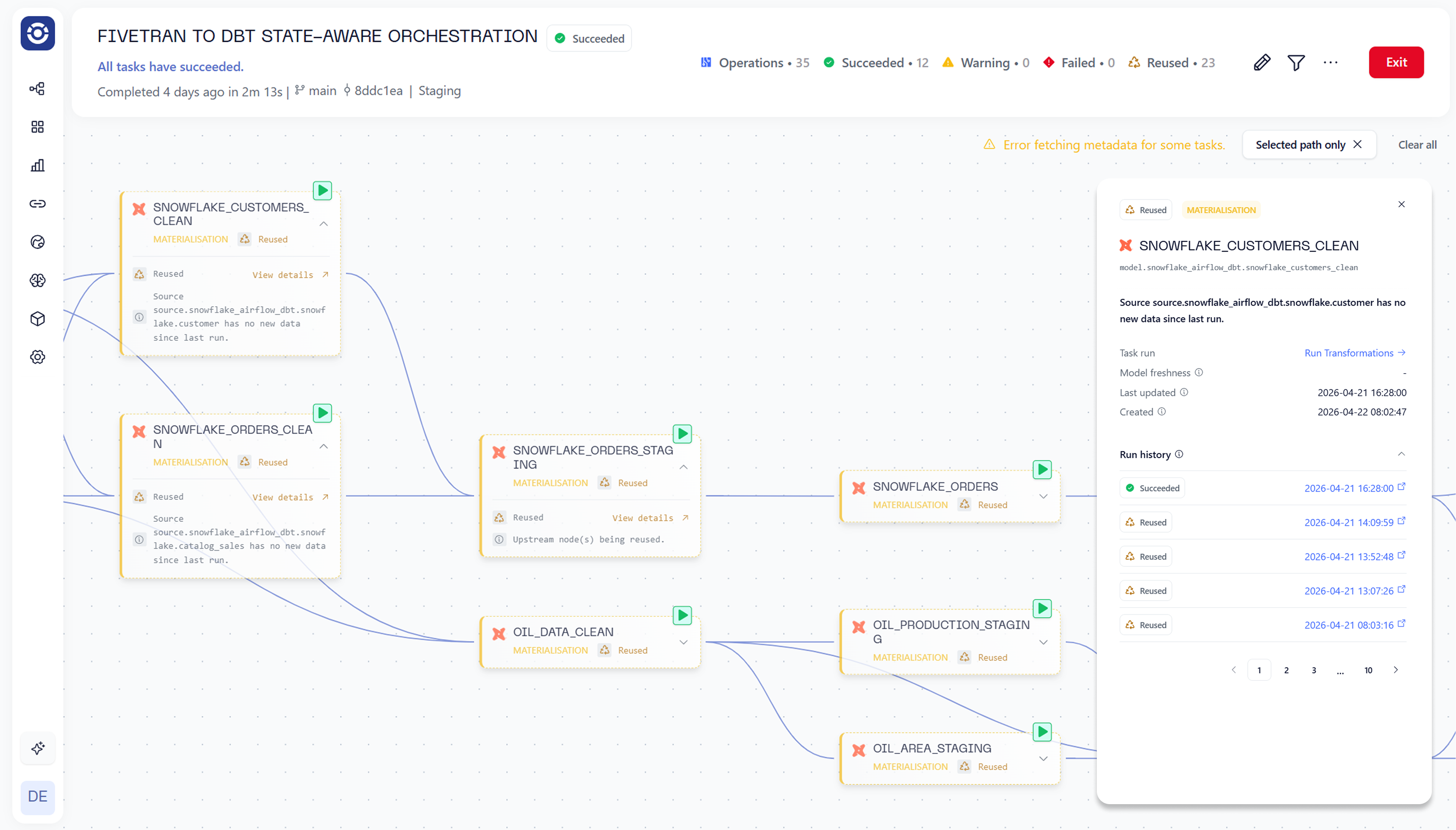
Orchestra is the orchestration and observability layer that unifies an MLOps stack for generative AI pipelines. It coordinates data, training, deployment and inference steps across whatever tools you choose, with end-to-end lineage and freshness, so your stack behaves like one coherent system rather than a pile of disconnected services.
MLOps maturity: where is your team?
Not every team needs the same stack, because not every team is at the same level of maturity. A useful way to locate yourself:
- Ad hoc: models trained in notebooks and deployed by hand. Fine for experiments, fragile for anything real.
- Repeatable: training and deployment are scripted and version-controlled, but largely manual to trigger.
- Automated: pipelines retrain, evaluate and deploy with minimal human intervention, gated by automated checks.
- Optimised: continuous monitoring drives automatic retraining, and the system largely maintains its own quality.
The mistake is to buy a stack designed for the optimised level when you are still ad hoc — you end up operating tools you do not yet need. Build the stack that fits your current maturity and the next step up, not a hypothetical future two levels away.
Evaluation: the hardest part of generative AI MLOps
If there is one capability that separates serious generative AI teams from the rest, it is evaluation. Because outputs are non-deterministic and often have no single correct answer, you cannot rely on a simple accuracy metric. Mature teams build evaluation harnesses that combine several signals: curated test sets with reference answers, rubric-based scoring, LLM-as-judge for scale, and human review for the cases that matter most. Crucially, they run these evaluations automatically on every change — new prompt, new model version, new retrieval configuration — and they grow the test set every time the system fails in a new way. Without this, you are shipping changes on vibes and discovering regressions from users. Evaluation is the gate that makes everything else in the stack safe, and it deserves first-class investment.
Bringing it together with orchestration
The layers described in this guide — data, training, deployment, serving, observability — only deliver value when they operate as one system. That coordination is the job of orchestration: triggering retraining when data or drift signals warrant it, running evaluation gates before promotion, coordinating deployment with the freshness of features and indexes, and maintaining lineage across the whole flow. An MLOps stack without strong orchestration is a set of capable parts that do not quite add up; with it, the same parts become a coherent, observable, generative AI pipeline. This is the connective tissue that turns a tool list into a platform, and it is where reliability ultimately lives.
Cost management in generative AI stacks
Cost deserves explicit attention because generative AI can become ruinously expensive without it, and the spend concentrates in places traditional MLOps never had to manage. Inference is usually the largest line item: every request to a large model costs money, and at scale those fractions of a cent add up fast. The levers that keep it under control are part of the stack design, not an afterthought — caching repeated queries, routing simple requests to smaller and cheaper models while reserving large models for genuinely hard ones, trimming prompt and context length, and batching where latency allows. Training and fine-tuning add their own costs, as does the storage of large artefacts and vector indexes, which is why storage decisions covered in storage for AI pipelines feed directly into the economics of the stack. The teams that operate generative AI affordably are the ones that treat cost as a first-class metric, monitored per pipeline and per request through their observability layer, and optimised deliberately. Cost ignored at design time has a way of arriving as a shocking invoice later, and retrofitting efficiency is far harder than building it in.
The generative AI tooling landscape will keep churning, with new models, frameworks and services arriving faster than anyone can evaluate them. That churn is precisely why a modular, orchestrated stack beats betting everything on a single platform: it lets you adopt the best new component for each layer without rebuilding the whole system. Anchor the stack on strong data foundations, rigorous evaluation, disciplined cost management and unifying orchestration, and you can ride the wave of improvements rather than being upended by it.
Conclusion
The best MLOps stack for generative AI pipelines is modular, observable and orchestrated — spanning data, training, deployment, inference and governance. Design your data layer and storage carefully, treat inference as a first-class pipeline, and tie it all together with orchestration rather than glue code.