For teams building machine learning on Google Cloud, Vertex AI Pipelines is the managed service for orchestrating reproducible ML workflows. This guide explains how Google Vertex AI Pipelines work, when a Vertex AI pipeline is the right choice, the practicalities of running pipelines on Vertex AI, and how it fits into a broader, multi-tool data and AI stack.
What are Vertex AI Pipelines?
Vertex AI Pipelines is a serverless service for running ML workflows defined as a directed graph of containerised steps. You author pipelines with the Kubeflow Pipelines SDK or TFX, compile them to a definition, and Vertex executes them on managed infrastructure — tracking parameters, artefacts and lineage along the way. The appeal is reproducibility and zero infrastructure management: you describe the workflow, Google runs it.
Conceptually, a Vertex AI pipeline is one implementation of the broader idea covered in what an AI pipeline is — specialised for the training and deployment portions of the ML lifecycle on Google Cloud.
How Google Vertex AI Pipelines work
Components and the DAG
Each step in a Vertex AI pipeline is a component — a containerised unit with defined inputs and outputs. Components are wired into a DAG, and Vertex schedules them based on their dependencies, running independent steps in parallel.
Artefacts, metadata and lineage
Vertex automatically records the artefacts each step produces and the metadata around them, building a lineage graph you can inspect. This is central to reproducibility: you can see exactly which data and parameters produced a given model.
Managed execution
Pipelines run serverlessly, scaling resources per step — including GPUs and TPUs for training — without you managing a cluster. You pay for what each step consumes.
When to use a Vertex AI pipeline
- You are committed to Google Cloud and want managed, reproducible ML workflows.
- You need automatic artefact and lineage tracking for governance and reproducibility.
- You want serverless scaling for training and batch inference without managing infrastructure.
- Your team is comfortable with the Kubeflow Pipelines or TFX authoring model.
If you are multi-cloud, orchestrate many non-ML steps, or need a single pane over your entire data and AI estate, you will likely pair Vertex with a higher-level orchestrator rather than using it alone.
Best practices for running pipelines on Vertex AI
- Keep components small and single-purpose so they are reusable and cacheable.
- Use caching to skip steps whose inputs have not changed, cutting cost and time.
- Parameterise pipelines so the same definition serves dev, staging and production.
- Add evaluation gates before deployment, as covered in our AI CI/CD pipeline guide.
- Mind storage and data movement — see storage for AI pipelines for how it affects cost and throughput.
Vertex AI Pipelines in a wider stack
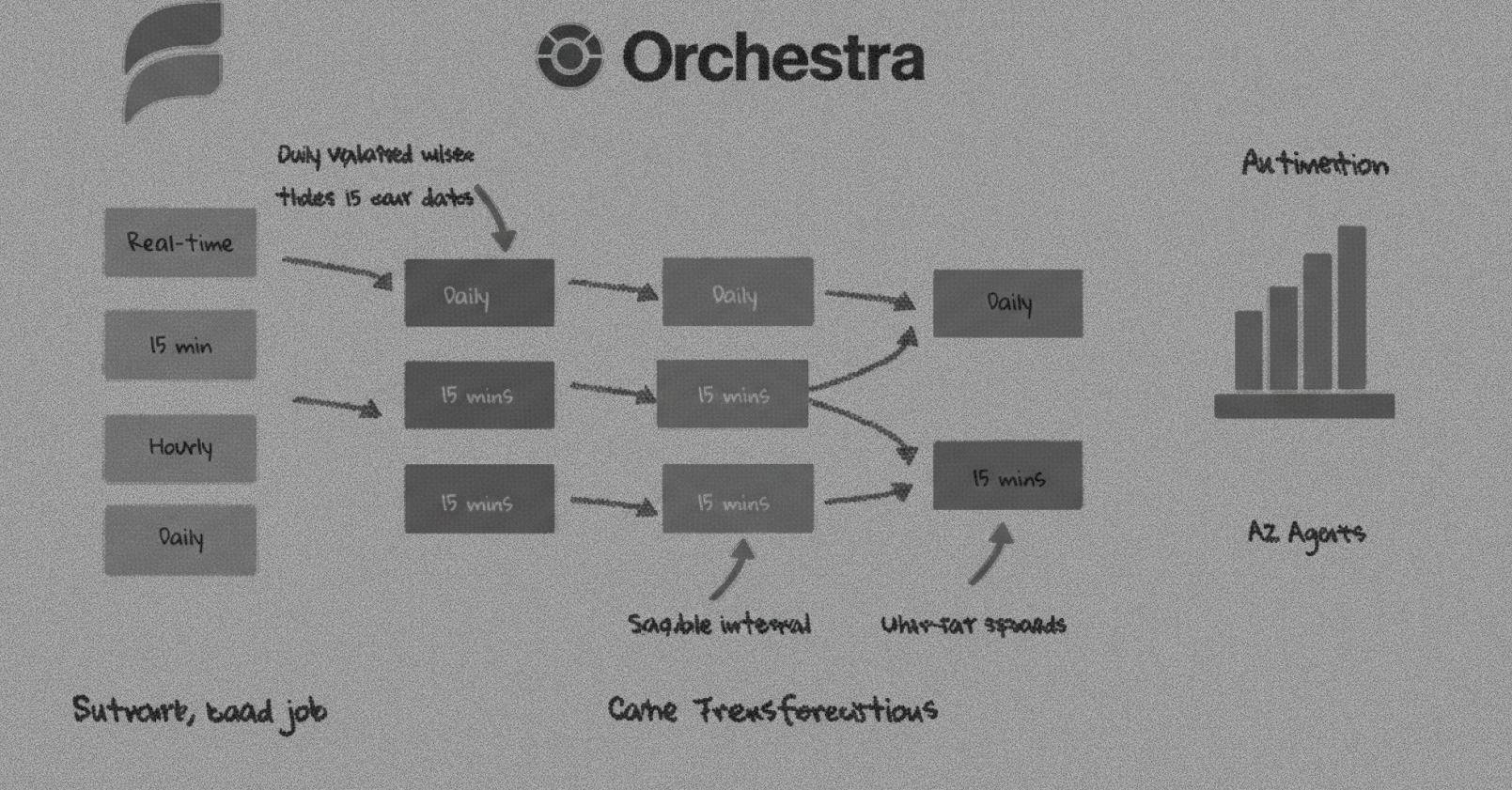
Vertex AI Pipelines excels at the ML lifecycle on Google Cloud, but real organisations run far more than training jobs: ingestion, transformation, analytics, reverse ETL, agents and more, often across clouds. A common pattern is to use Vertex for the ML steps while a platform-agnostic orchestrator coordinates the end-to-end flow, so freshness and lineage span the whole system rather than stopping at the Vertex boundary. This connects naturally to your broader MLOps stack.
Vertex AI Pipelines vs. other orchestrators
How does Vertex AI Pipelines compare to the alternatives? Against open-source Kubeflow Pipelines, Vertex is essentially a managed version — you trade some control for not running the cluster yourself. Against general-purpose orchestrators, Vertex is more specialised: it is excellent for the ML lifecycle on Google Cloud but is not designed to be the single control plane for an entire data estate spanning ingestion, analytics and reverse ETL across multiple clouds. And against fully managed end-to-end ML platforms, Vertex is more of a building block you compose with the rest of the Google Cloud ecosystem. The practical conclusion for most teams is that Vertex AI Pipelines is a strong choice for the training and deployment steps, used inside a broader orchestration strategy rather than as the whole of it.
Cost considerations on Vertex AI
Because Vertex AI Pipelines is serverless, cost is driven by what each step consumes — CPU, memory, GPUs and TPUs — plus pipeline run overhead and the storage of artefacts and metadata. A few habits keep the bill predictable:
- Lean on caching so unchanged steps are skipped on reruns rather than recomputed.
- Right-size each component’s resources rather than over-provisioning the whole pipeline.
- Clean up artefacts with lifecycle policies so metadata and intermediate outputs do not accumulate indefinitely.
- Avoid unnecessary reruns by triggering pipelines on data and state changes rather than a blunt schedule.
A typical Vertex AI pipeline workflow
In practice, a Vertex AI training pipeline tends to follow a familiar shape: a data-validation component checks the incoming dataset against expectations; a preprocessing component builds features; a training component fits the model, often on GPUs; an evaluation component compares the candidate against the current production model; and a conditional deployment component promotes the model only if it clears the evaluation bar. Each step is cached, versioned and tracked, so any model in production can be traced back to the exact data and code that produced it — the reproducibility that makes Vertex AI Pipelines appealing for regulated and high-stakes workloads.
How Orchestra fits
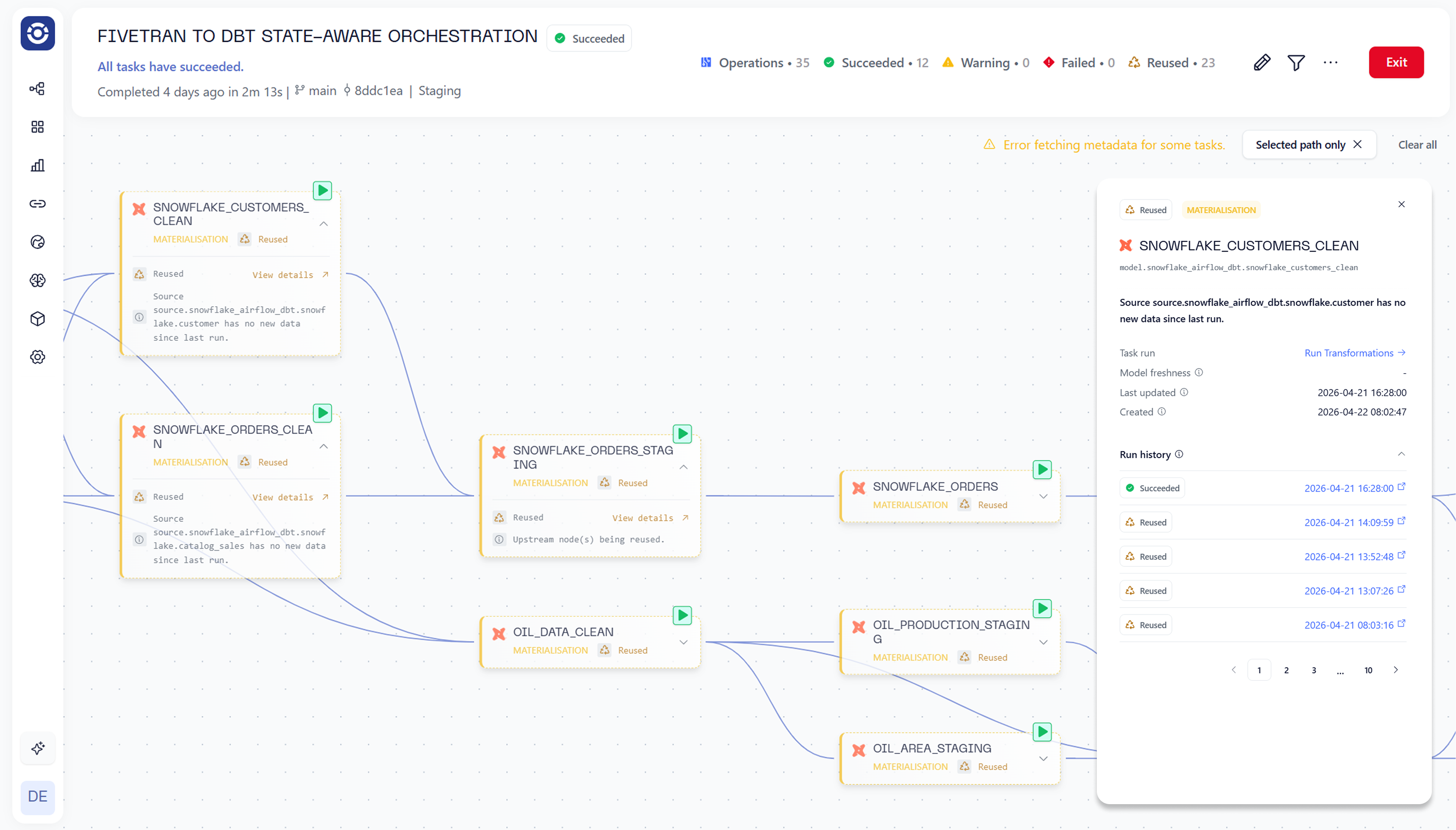
Orchestra orchestrates Vertex AI Pipelines alongside the rest of your stack from a single control plane, triggering Vertex runs as part of a larger workflow and unifying lineage and freshness across Google Cloud and beyond. You keep Vertex’s managed ML execution while gaining end-to-end visibility and recovery.
Authoring components: KFP and TFX
Two authoring approaches dominate Vertex AI Pipelines, and the choice shapes your developer experience. The Kubeflow Pipelines (KFP) SDK is the more general and widely used option: you write Python functions, decorate them as components, and wire them into a pipeline, with Vertex handling containerisation and execution. TFX (TensorFlow Extended) offers a more opinionated, end-to-end set of standard components for production ML — data validation, transformation, training, evaluation and serving — which is powerful if your workflow fits its conventions and heavier if it does not. Most teams starting today reach for the KFP SDK for its flexibility, adopting TFX components selectively where its batteries-included approach genuinely helps. Either way, the discipline of small, single-purpose, cacheable components applies.
Integrating Vertex with the rest of Google Cloud
A Vertex AI pipeline rarely lives in isolation; its value grows through integration with the surrounding Google Cloud ecosystem. Pipelines commonly read from and write to BigQuery and Cloud Storage, register models in the Vertex Model Registry, deploy to Vertex endpoints for serving, and emit metadata that feeds governance and lineage tooling. Understanding these integration points helps you decide what belongs inside a Vertex pipeline and what belongs in the broader orchestration around it. Data preparation that spans many non-ML systems, for instance, is often better handled upstream, with Vertex focused on the training and deployment steps it does best. The cleaner that boundary, the easier the whole system is to operate and reason about.
When Vertex AI Pipelines is not the right fit
For balance, it is worth being clear about where Vertex is not ideal. If you are multi-cloud or on-premises, a Google-specific service constrains you. If most of your workflow is data engineering and analytics rather than ML training, a general-purpose orchestrator fits better. If your team is not invested in the Kubeflow or TFX model, the authoring overhead may outweigh the benefits for simpler needs. And if you want a single control plane over your entire data and AI estate — with unified lineage and freshness across every tool — Vertex alone will not provide it, because its scope is the ML lifecycle on Google Cloud. Recognising these boundaries lets you use Vertex for what it is genuinely excellent at, rather than stretching it into a role it was not designed to fill.
Getting started with Vertex AI Pipelines
If you are new to Vertex AI Pipelines, a measured on-ramp avoids the common early frustrations. Begin with a single, simple pipeline — even a two- or three-step train-and-evaluate flow — to learn the authoring model and the execution lifecycle before tackling anything ambitious. Lean on caching from day one so iteration is fast and cheap. Parameterise the pipeline early so the same definition serves development and production rather than maintaining divergent copies. Add an evaluation gate before any deployment step, so promotion is conditional on quality, as discussed in our AI CI/CD pipeline guide. And from the outset, think about how the pipeline will be triggered and how it fits the wider workflow — a Vertex pipeline that runs in isolation delivers far less than one orchestrated as part of an end-to-end flow with unified lineage and freshness across your MLOps stack. Starting small, caching aggressively and planning the integration early will get you productive quickly while avoiding the rework that comes from over-engineering a first pipeline before you understand the service.
Conclusion
Vertex AI Pipelines is a strong managed option for reproducible ML workflows on Google Cloud, with excellent artefact and lineage tracking. Use it for the ML lifecycle, follow the caching and component best practices, and orchestrate it within a wider system so your automation and visibility cover the whole AI pipeline, not just the parts that run on Vertex.