Ask ten engineers “what is an AI pipeline?” and you will get ten slightly different answers. That is because the term AI pipeline spans everything from a notebook that trains a single model to a production system that ingests millions of events, retrains models nightly, and serves predictions under tight latency budgets. This guide gives a precise, practical definition of AI pipelines, walks through the AI pipeline workflow stage by stage, and covers the architecture decisions and best practices that separate fragile experiments from reliable pipeline AI systems.
What is an AI pipeline?
An AI pipeline is the end-to-end, automated workflow that moves data through every step required to build, deploy and operate an AI system — from raw ingestion through transformation, training, evaluation, deployment, and ongoing monitoring. Where a script does one thing once, an AI pipeline chains those steps into a repeatable, version-controlled process that can run on a schedule, in response to new data, or on demand.
The word “pipeline” is doing real work here. Just as a physical pipeline moves a substance from source to destination through a series of controlled stages, an AI pipeline moves data from its source to a deployed model and beyond. Each stage has clear inputs, outputs and contracts, and the whole thing is designed to be observable and recoverable when something breaks.
AI pipeline vs. data pipeline vs. ML pipeline
These terms overlap, which causes endless confusion. A useful way to separate them:
- A data pipeline moves and transforms data. It does not necessarily involve any model. See our deep dive on the AI data pipeline for how modern data pipelines feed AI.
- An ML pipeline focuses on the machine learning lifecycle: feature engineering, training, evaluation and deployment of models.
- An AI pipeline is the superset: it includes the data pipeline that feeds it, the ML or model layer, and increasingly the inference and agent layers that consume the outputs. In generative and agentic systems the “model” may be a hosted LLM rather than something you train, but the pipeline concept is identical.
The AI pipeline workflow: core stages
Almost every AI pipeline workflow can be decomposed into the same logical stages. The technology changes; the shape does not.
1. Data ingestion
The pipeline pulls data from source systems — databases, event streams, APIs, files in object storage. Good ingestion is incremental (it processes only what is new), idempotent (re-running it does not duplicate data), and contract-checked at the boundary so malformed input is caught before it propagates downstream.
2. Data transformation and feature engineering
Raw data is cleaned, joined, deduplicated and reshaped into the features a model needs. This is where much of the value — and most of the bugs — live. Treat transformations as code: tested, version-controlled, and reproducible.
3. Training or model selection
For classical ML this is model training and hyperparameter tuning. For generative AI it may be fine-tuning, retrieval-index construction, or simply selecting and configuring a foundation model. Either way, the artefacts produced must be versioned so you can reproduce and roll back.
4. Evaluation
Before anything ships, the pipeline evaluates quality against held-out data and guardrail metrics. An AI pipeline that deploys without an automated evaluation gate is an outage waiting to happen.
5. Deployment and inference
Approved models are deployed to a serving environment — a batch scoring job, a real-time endpoint, or an agentic AI pipeline that calls tools and other models. Inference is itself a pipeline stage with its own latency, cost and reliability characteristics.
6. Monitoring and feedback
Once live, the pipeline watches for data drift, model degradation, freshness violations and failures, feeding signals back to trigger retraining or alerting. We cover this in depth in AI pipeline monitoring and observability.
AI pipeline architecture: batch, streaming and real-time
AI pipelines come in three broad architectures, and most real systems blend them:
- Batch pipelines run on a schedule and process data in bulk. Simple, cheap, and the right default for training and many scoring workloads.
- Streaming pipelines process events continuously, keeping features and predictions fresh for use cases like fraud detection or recommendations.
- Real-time inference pipelines serve predictions synchronously behind an API, trading throughput for low latency.
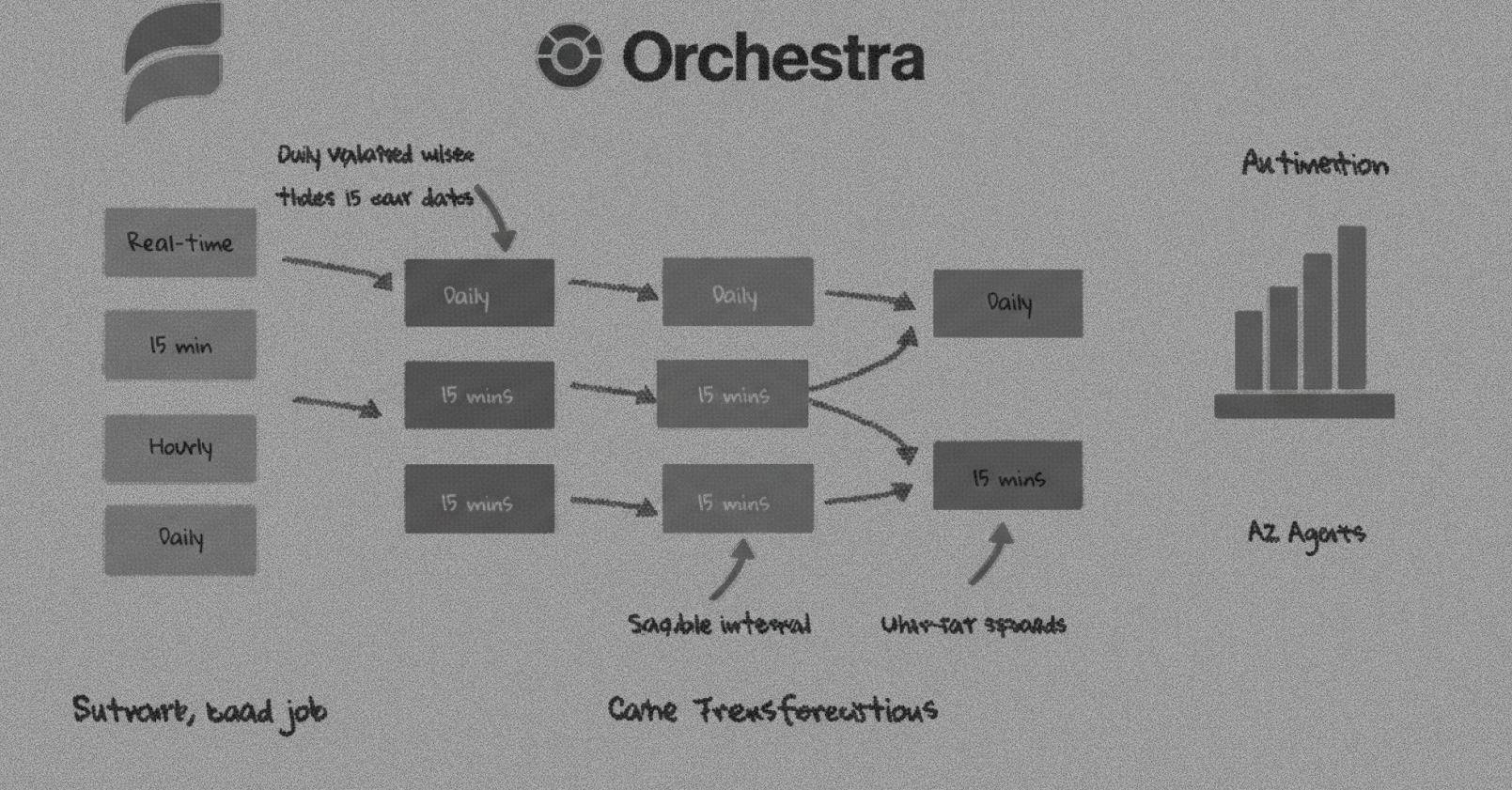
The orchestration layer — the system that decides what runs, when, and in what order — is what holds these together. As pipelines grow, clock-based scheduling gives way to event- and state-driven execution, where downstream work is triggered by the freshness needs of consumers rather than a fixed cron.
Why AI pipelines matter
The model is the glamorous part, but the pipeline is what determines whether an AI system is actually usable in production. A brilliant model fed by a broken pipeline produces confidently wrong answers. A modest model on a reliable, observable, well-governed pipeline can run a business. Three reasons pipelines are the real differentiator:
- Reliability: AI consumers attach to data directly, so stale or incorrect data is no longer a reporting nuisance — it is a correctness bug that reaches users.
- Velocity: a good pipeline lets teams ship changes daily instead of quarterly, because every step is automated and reversible.
- Governance: pipelines are where lineage, access control and audit live. You cannot govern AI you cannot trace.
Best practices for building reliable AI pipelines
- Make every stage idempotent and replayable so recovery means re-running the minimum necessary work, not the whole graph.
- Enforce data contracts at boundaries and fail closed, so bad data never silently reaches a model or a consumer.
- Version everything — data, code, model artefacts and configuration — so any run is reproducible.
- Automate evaluation gates before deployment, not after incidents.
- Invest in observability early. You cannot fix what you cannot see, and you cannot automate recovery for failures you do not detect.
- Choose the right automation layer. Explore your options in our guide to AI pipeline automation tools.
Common AI pipeline mistakes to avoid
The failure modes of AI pipelines are remarkably consistent across teams and industries. Knowing them in advance is half the battle:
- Treating the model as the product. Teams pour months into model quality and weeks into the pipeline, then wonder why the system is unreliable in production. The pipeline is the product; the model is one component.
- No evaluation gate. Shipping a new model or prompt without an automated quality check against held-out data is the single most common cause of AI regressions reaching users.
- Clock-based scheduling everywhere. Rebuilding the whole graph on a fixed cron wastes compute and still leaves data stale between runs. Event- and state-driven execution is almost always better as pipelines mature.
- Observability as an afterthought. Bolting on monitoring after the first outage means you spend that outage flying blind. Instrument from day one.
- Ignoring lineage. Without it, the question “what is affected by this bad data?” turns every incident into a multi-team investigation.
How to start building an AI pipeline
You do not need to build the whole thing at once. The teams that succeed start small and harden incrementally:
- Map the end-to-end flow first. Sketch every stage from source to consumer before you write code, so you understand the dependencies and contracts you are committing to.
- Pin the boundaries with contracts. Add data contracts at ingestion and at exposures so the pipeline’s external behaviour is stable while you iterate internally.
- Make one stage reliable, then the next. Get ingestion idempotent and incremental before you optimise transformation; get evaluation automated before you scale serving.
- Add observability and recovery early, not after the first 2am page.
- Choose an orchestration layer that can grow with you rather than a pile of cron jobs you will later have to untangle.
The future of AI pipelines
Two trends are reshaping how AI pipelines are built. The first is the shift from clock-based to state-aware execution, where pipelines process only what has changed and propagate freshness requirements up the dependency tree — cutting cost and latency while improving reliability. The second is the rise of agentic systems that not only run pipelines but help build and repair them. Both raise the importance of the fundamentals in this guide: contracts, lineage, observability and governance. The more autonomous the pipeline becomes, the more it needs a trustworthy foundation underneath it.
Where Orchestra fits
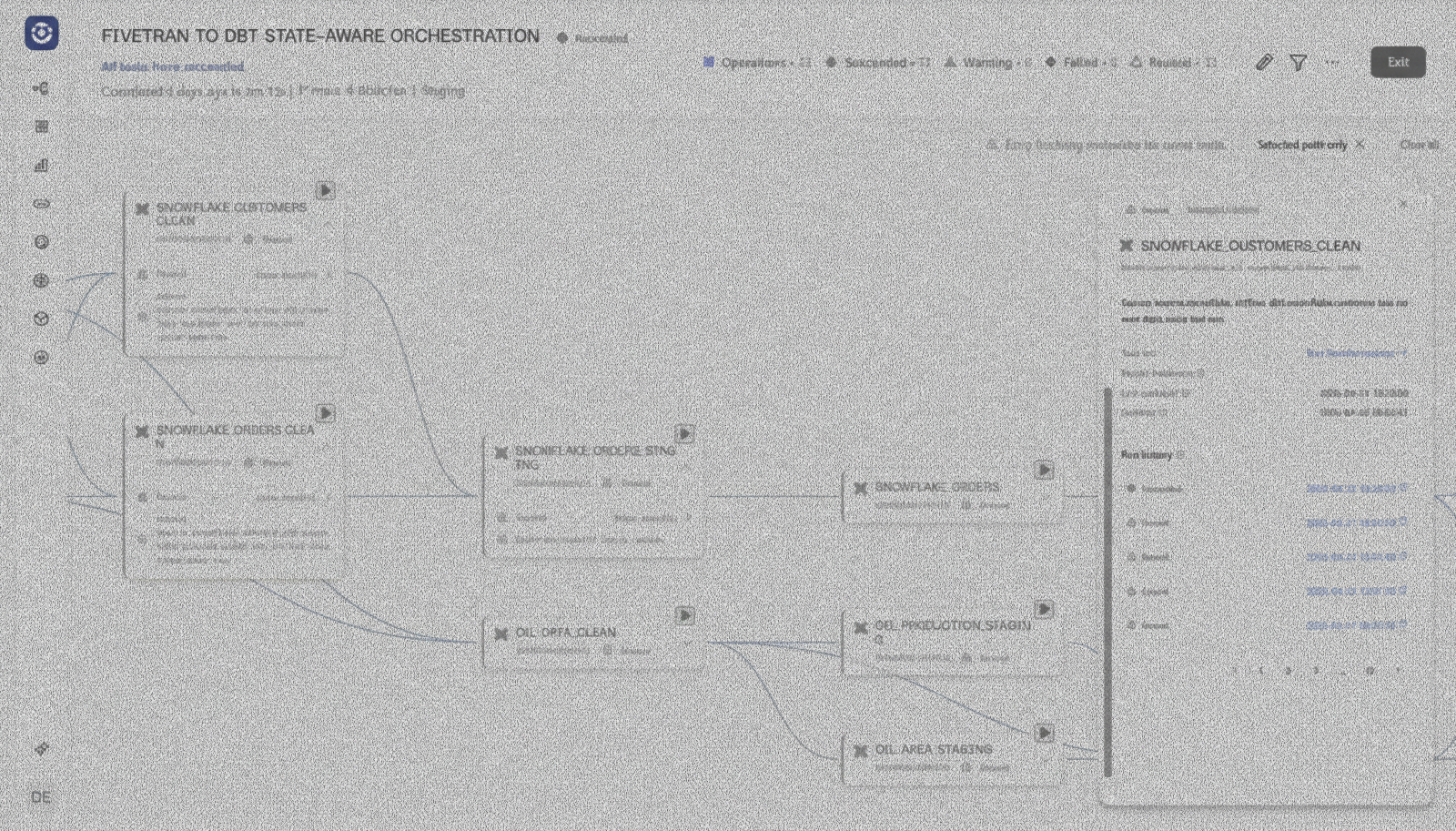
Orchestra is a single control plane for building, running and monitoring data and AI workflows. Rather than stitching together schedulers, transformation tools and observability with bespoke glue code, teams use Orchestra to orchestrate the entire AI pipeline workflow end to end — with lineage, freshness SLAs and recovery built in. The result is the boring, reliable kind of pipeline AI that you can actually trust in production.
AI pipeline examples across industries
The same pipeline shape recurs everywhere, which is the best evidence that these patterns are fundamental. In retail, AI pipelines power recommendations and demand forecasting. In finance, they drive fraud detection and risk scoring on streaming data. In healthcare and life sciences, they underpin the AI drug discovery pipeline and clinical decision support. In go-to-market teams, they feed sales forecasting and pipeline generation. The sources, models and consumers differ, but every one of these is an end-to-end flow from data to a deployed, monitored AI system — ingestion, transformation, model, inference and monitoring — which is exactly the definition we started with. Learn the shape once and you can read any AI system in any domain.
Conclusion
An AI pipeline is not one tool or one model — it is the disciplined, automated workflow that carries data from source to a deployed, monitored AI system. Get the stages, the architecture and the operational practices right, and the model almost takes care of itself. Start with the AI data pipeline that feeds everything, then layer on monitoring and automation as you scale.